plus/minus epsilon
Underwater Communication
7 Jan 2026I’ve decided that I would like to build a submarine. Ideally, I'd build one that I could ride inside of, but due to various practical constraints, mostly being money, and the fact that my apartment building has rules against storing boats in the garage, and my desire to stay alive, I'll start with a miniature submarine.
The first substantial problem that we'll need to solve in this project is underwater communication. A lot of people claim to have built a submarine but then use something like a fiber optic cable for communication with land. If a submarine needs a physical connection to land then it's not a submarine, it's a submersible, which is less cool.
The only options that I see for communication medium are: 1.) the electromagnetic spectrum, or 2.) acoustics.
Electromagnetic Spectrum
Water pretty aggressively absorbs certain frequencies of the electromagnetic spectrum. The easiest way to see this is by simply putting your phone in water. In my own experiment with this, four inches of salty water was enough to take my phone to one bar of cell signal and prevent my wireless earbuds from working consistently.
To get a clearer sense of which frequencies will or won’t work, we can graph the frequency of electromagnetic waves against that frequency’s ability to successfully penetrate liquid water. This seems to usually be graphed as wavelength, measured in nanometers, against “absorption”, measured in the unit cm^-1, where both axes are log scale. That graph is below and to the left. However, the graph below and to the right is the same data but with wavelength converted to frequency and with the vertical axis linear instead of logarithmic. This format is easier for me to understand.
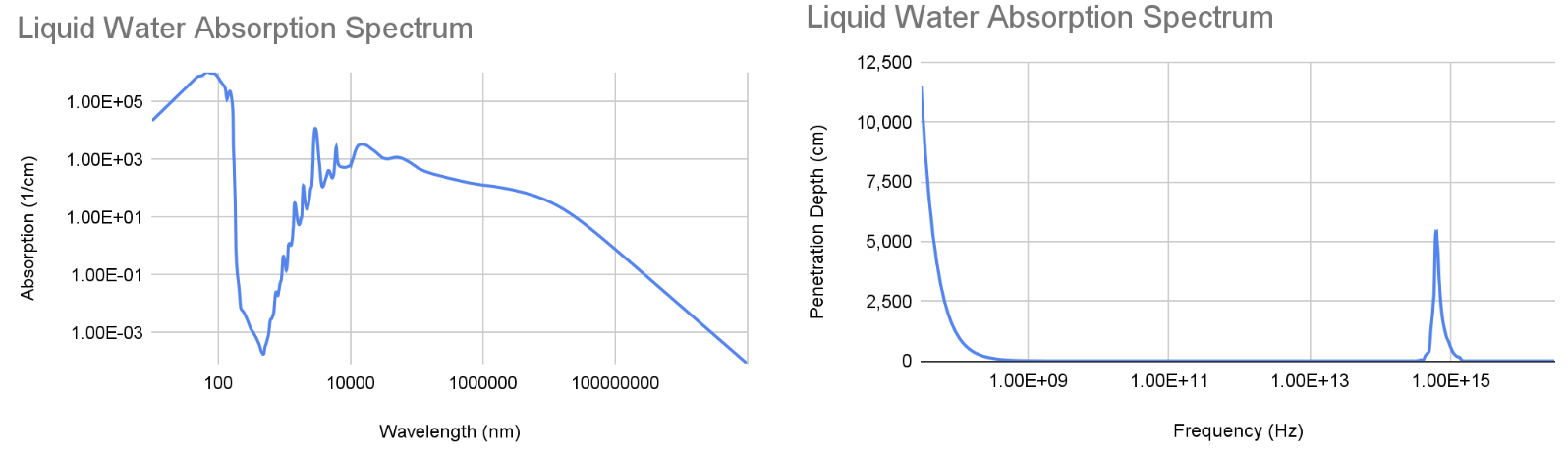
Here, we can see that the right graph has a spike around 618 THz (a wavelength of 485 nanometers), corresponding to blue light in the visible spectrum. But we can also see that, starting around 200 MHz, penetration starts increasing quickly as frequency decreases. This entire range consists of radio waves. Around 44 MHz, radio waves start to penetrate water more effectively than blue light.
The lowest either of these graphs go is 30 MHz. I was curious why this is (perhaps the trend of better penetration continues at even lower frequencies…?), when I stumbled upon the wiki page for the US Navy’s Project Sanguine. This was a project planned for the explicit purpose of communication with submarines (relevant!) by constructing an antenna over two-fifths of Wisconsin.
Generally speaking, antennas usually need to be roughly proportional in size to the wavelength they're intended to broadcast on. The antenna the Navy ended up building operated at 76 Hz, corresponding to a wavelength of 3.9 million meters. This would naively require an antenna roughly 600 miles long, but through various tricks the Navy got away with building only an 84 mile long antenna.
Even with such tricks, broadcasting at such low frequencies seems to become difficult very quickly, especially if you want to broadcast from within the submarine (not just have the submarine as a receiver). As such, the only particularly viable option in this space is blue light (wavelength 485 nm). Blue light unfortunately doesn't diffract like typical radio waves and is easily blocked by physical obstructions or murky water.
Acoustics
This leads us to option two: acoustic communication. I assumed at first that this would actually be the harder of the two options. Sound waves move at the speed of sound rather than the speed of light, and this causes two problems: 1.) it substantially reduces the maximum possible bandwidth of any communication channel, and 2.) it introduces the possibility of interference from echoes. Do radio waves echo? I mean yes, but it doesn't seem to be a first-class concern. Sound waves obviously echo and slowly at that, which is why someone speaking continuously in an echoey environment becomes almost unintelligible. What they said seconds or hundreds of milliseconds ago interferes with what they're saying now and creates mush.
However while researching this, I very quickly found the NATO publication for JANUS, which is a standardized protocol for NATO submarines and other underwater assets to communicate with each other. JANUS defines a specific bit format for packets, obviously, and those packets end with an 8-bit CRC code. Packets are then passed through two further processing steps: 1.) a convolutional encoding followed by interleaving, and 2.) assignment to specific frequency bands.
Convolutional encoding is a forward error correction technique that adds redundancy to a continuous stream of data. It works by passing the input bits through a sliding window mechanism, where each output bit is determined not only by the current input but also by a history of previous inputs. This process creates a dependency between successive bits and allows receivers to use probabilistic methods, such as the Viterbi algorithm, to reconstruct the original message even if some data is corrupted. The key feature seems to be that a receiver can input a probability to the decoder when it's unclear from analog sensors whether a 0 or a 1 was intended to be signalled. Interleaving is then used to rearrange the output bits, to prevent a burst of noise from corrupting several consecutive bits.
The second step is to then map these encoded bits to sound frequencies that can be physically emitted, for which JANUS specifies Frequency-Hopped Binary Frequency Shift Keying. Binary Frequency Shift Keying refers to the idea of broadcasting on one frequency to indicate a 1, and broadcasting on another frequency to indicate a 0. This is combined with Frequency Hopping, where the frequencies corresponding to either a 0 or 1 are programmatically changed after each bit. The purpose of frequency hopping is to minimize the amount of time spent broadcasting or listening on any specific frequency, which helps reduce interference from echoes and other transmitters.
The sound frequencies used by JANUS range from 9.44 kHz to 31.25 kHz. This overlaps with a surprising amount of the hearing range of both humans and animals. I wonder if the fish care.